Dental Implants Bakersfield/ Implant Bridges in Bakersfield, CA
Two implants, three teethFixed, not removableSedation availableSecond opinions welcome
Replace three or four teeth in a row with a fixed bridge held by two or three implants. Fewer implants than teeth, and your natural teeth stay untouched.

 ADA
American Dental Association
ADA
American Dental Association
 Calaoms
California Association Of Oral and Maxillofacial Surgeons
Calaoms
California Association Of Oral and Maxillofacial Surgeons
 ABOMS
American Board of Oral and Maxillofacial Surgery
ABOMS
American Board of Oral and Maxillofacial Surgery
 AAOMS
American Association of Oral and Maxillofacial Surgeons
AAOMS
American Association of Oral and Maxillofacial Surgeons
 Board-Certified ABOMS
Board-Certified Oral & Maxillofacial Surgeon
Board-Certified ABOMS
Board-Certified Oral & Maxillofacial Surgeon
Overview
An implant bridge replaces several teeth in a row using fewer implants than teeth.
Two implants go in at each end of the gap. A single fixed bridge spans between them, carrying a crown for every missing tooth. The tooth in the middle has no implant under it and is carried by the two on either side.
It is used when:
For one missing tooth, a single implant is the answer. For a whole jaw, a full arch option is. This sits in between.
The floating tooth in the middle is called a pontic. It sits just above the gum with a small space underneath, which is why cleaning under it becomes part of your routine.
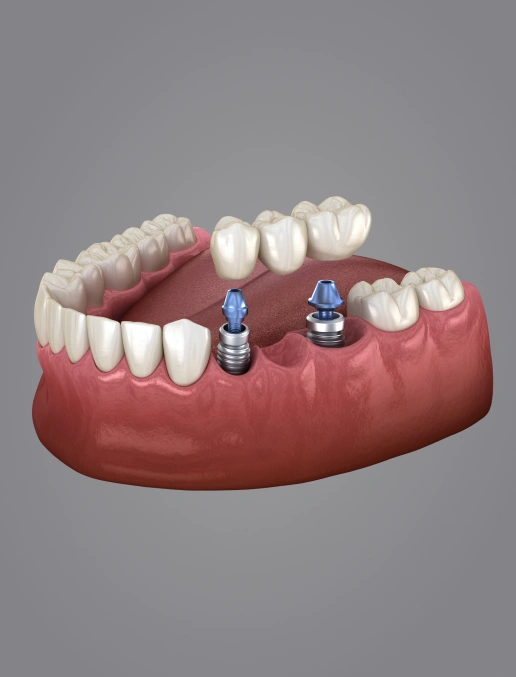
How it works
Tap through by how many teeth you are missing. Watch what happens to the stretch of bridge with nothing under it.
Tap through by how many teeth are missing.
A bridge is rigid only if its anchors are close enough together. Put them too far apart and it flexes every time you bite, which loosens screws and eventually cracks things.
So the rule is simple: keep any unsupported stretch short. One floating tooth between two implants is well proven. Two floating teeth in a row is where most surgeons add a third implant instead.
What the scan is checking:
A bridge should not be anchored to an implant at one end and a natural tooth at the other. Implants do not move and natural teeth do, slightly. Joining them puts strain on both.
Timeline
This is a smaller operation than most people expect, because you are having two implants rather than one per tooth.
The short version:
Drag the slider for each stage.
Pain gets worse after day three instead of better, swelling grows after three days, or you run a fever.
Six stages from consultation to finished bridge.
Benefits
The comparison that matters is against replacing every tooth with its own implant.
| Implant bridge | One implant each | |
|---|---|---|
| Implants placed | 2 | 3 |
| Surgical sites | 2 | 3 |
| Cost | Lower | Higher |
| Bone needed | At both ends only | At every position |
| Cleaning | Clean under the floating tooth | Floss like normal teeth |
| If one implant fails | The whole bridge is affected | Only that tooth |
| Feels like | Fixed, does not move | Fixed, does not move |
Separate implants win on repairability. A bridge wins on surgery, cost and how much bone you need. Both give you fixed teeth.
Why most people choose the bridge:
If you wait
A single missing tooth is a local problem. Three in a row changes how your whole mouth works, and the damage shows up on the side you still chew with. Tap through it.
What actually goes wrong:
Pricing
Implants are the expensive part, so the count matters more than the number of teeth.
A three-tooth bridge on two implants costs less than three separate implants. A four-tooth bridge usually needs a third implant, which brings it back up. That is the whole shape of the pricing.
Tick the boxes and take the list to any consultation, including ours.
This is one case where insurance often helps more than you would expect. Plans that exclude implants frequently still pay toward crowns, and a bridge has three or four of them. Worth filing a pre-estimate before you commit. Financing through Proceed Finance is available, subject to approval.
Credentials
Dr. Sam Harouni, DDS. Oral and maxillofacial surgeon in Bakersfield.
Bridges live or die on implant position. Getting two anchors placed so the span between them stays rigid, in bone that is often thinner across a wide gap, is the part that decides how long it lasts.

Exam, 3D scan and a measurement of the actual gap. You leave knowing whether two implants will do or a third is needed, with the price in writing.
FAQ
Three is the reliable answer. Two implants at the ends of the gap, with one floating tooth between them.
Four teeth on two implants means two floating teeth in a row, which is a long unsupported stretch. Most cases add a third implant instead. Beyond four teeth, a full arch option usually makes more sense.
A pontic. It is a full crown that sits just above the gum with a small space underneath, carried by the implants on either side.
That space is deliberate. It leaves room to clean under it, which is the one extra habit an implant bridge asks of you.
For normal chewing, yes. Where separate implants have the edge is in what happens later. If one implant has a problem, only that tooth is involved.
With a bridge, everything is joined, so one implant problem affects the whole bridge. That is the main trade for the lower cost and the smaller surgery.
You can, and sometimes it is the better plan. It costs more, needs more surgery, and needs enough bone at every position rather than just at the two ends.
For three teeth in a row, most people choose the bridge because the result feels identical and the price is meaningfully lower.
With a water flosser, or floss threaded under the pontic once a day. It takes a few extra seconds once you have the knack, and we show you before you leave.
This is not optional. Debris under a pontic is the most common cause of gum inflammation around an implant bridge.
Then a single bridge is usually the wrong answer. A bridge has to be one continuous piece, so separate gaps mean separate restorations.
Two gaps with a healthy tooth between them are normally treated as two separate implants or two small bridges, rather than spanning over the healthy tooth.
It is possible but generally avoided. A natural tooth moves very slightly in its socket under load and an implant does not move at all.
Joining the two means the tooth end takes strain the implant end does not absorb, which can loosen the tooth or the cement over time. Two implants is the cleaner design.
Usually porcelain fused to a metal or zirconia framework, or a single milled zirconia piece. Zirconia resists staining and chipping better.
Ask whether it is screwed on or cemented. Screwed on is generally preferred, because it can be removed cleanly for cleaning or repair without disturbing the implants.
The implants are built to last decades. The bridge on top is the wearing part, and may need replacing once across that time.
Longevity depends most on cleaning under the pontic and on whether you grind. A night guard is worth having if you do, since a bridge with a floating tooth is more sensitive to overnight force than a single crown.
Location
Serving: Bakersfield, Beverly Hills, Century City, Westwood, Brentwood, West Hollywood, Santa Monica, Bel Air, Sherman Oaks, Culver City and the greater West Los Angeles area.
Book a Consultation