Dental Implants Bakersfield/ Implant Overdentures in Bakersfield, CA
Two to four implantsSnaps in, lifts outOften local anesthetic onlySecond opinions welcome
A denture that clips onto implants instead of resting on your gums. It holds firm while you eat and talk, and you still take it out to clean.
 ADA
American Dental Association
ADA
American Dental Association
 Calaoms
California Association Of Oral and Maxillofacial Surgeons
Calaoms
California Association Of Oral and Maxillofacial Surgeons
 ABOMS
American Board of Oral and Maxillofacial Surgery
ABOMS
American Board of Oral and Maxillofacial Surgery
 AAOMS
American Association of Oral and Maxillofacial Surgeons
AAOMS
American Association of Oral and Maxillofacial Surgeons
 Board-Certified ABOMS
Board-Certified Oral & Maxillofacial Surgeon
Board-Certified ABOMS
Board-Certified Oral & Maxillofacial Surgeon
Overview
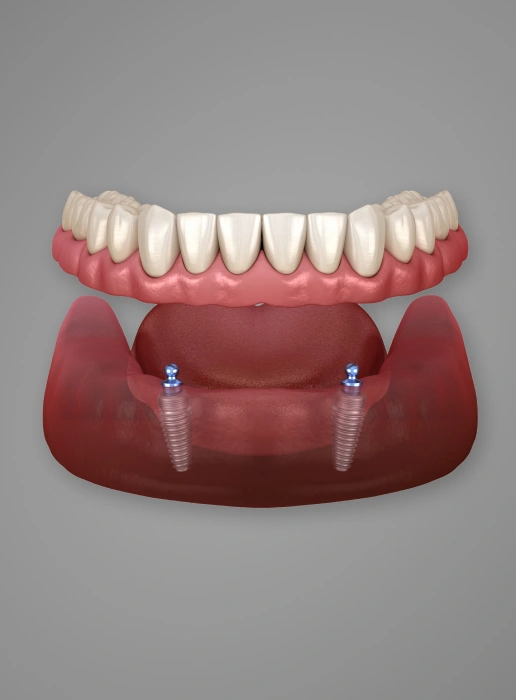
An implant overdenture is a denture that clips onto implants instead of resting on your gums.
Two to four implants go into the jaw. Attachments are fitted to them, matching sockets go into the denture, and it snaps down into place. It holds firm while you eat and talk, and you still lift it out to clean.
It is used when:
All-on-4 is fixed. Only your surgeon takes it off. An overdenture you remove yourself every night. Fewer implants, lower cost, and you clean it in your hand rather than around it in your mouth.
How it works
Everything about an overdenture comes down to what holds it. Tap between the two.
Tap to switch. Studs suit most lower jaws, a bar suits uppers and softer bone.
Both work the same way in principle. Something sits on the implants, something matching sits in the denture, and the two snap together.
How many implants:
More implants means more grip. The trade is cost, and slightly more to clean around.
The attachments hold by friction. There is a distinct click when it seats and a definite pull to remove it. Getting used to that takes a few days, and after that most people stop thinking about it.
Timeline
This is one of the smaller implant treatments. Two implants, one short surgery, and you keep wearing your denture throughout.
The short version:
The part quotes leave out: an overdenture has running costs. The nylon inserts that grip the studs wear down and need swapping. Below is roughly what to expect.
| What | How often |
|---|---|
| New nylon inserts | Every 6 to 18 months, depending on wear |
| Reline as the ridge changes | Every few years |
| Replace the denture itself | Roughly every 5 to 10 years |
| Hygiene visits | Twice a year, with the implants checked |
None of this is a hidden catch. It is cheaper and simpler than maintaining a fixed bridge. It is just worth knowing before you compare prices.
Six stages from consultation to the day it clicks in.
Benefits
An overdenture sits between a plain denture and a fixed bridge. Here is where it wins and where it does not.
| Plain denture | Overdenture | Fixed bridge | |
|---|---|---|---|
| Implants | None | 2 to 4 | 4 to 6 |
| Does it move? | Yes | No | No |
| Comes out | Yes | Yes, by you | No |
| Covers your palate | Yes, if upper | Usually, if upper | No |
| Chewing power | Low | Good | Closest to teeth |
| Cleaning | In your hand | In your hand | Around it, in place |
| Cost | Lowest | Middle | Highest |
| Upkeep | Relines | Inserts and relines | Checks and screw work |
What patients notice most:
Where it does not win: a fixed bridge chews better, leaves your palate clear, and needs no nightly routine. If those matter most, that is the treatment to look at.
If you wait
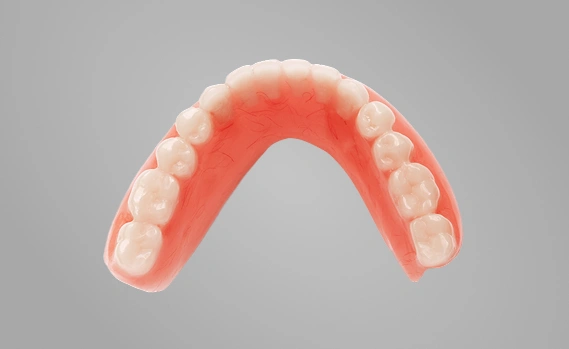
An upper denture gets suction from the palate. A lower one has nothing to seal against, so it never really holds. Tap through what that does over time.
Why this one is worth acting on:
Two implants is the smallest implant treatment there is, and on a lower denture it makes the biggest difference of anything in this field.
Find out where you standPricing
An overdenture is the least expensive way to get implants holding a full arch, and the only one with a genuine running cost.
Upfront, the price is set by: how many implants, whether you get studs or a bar, and whether your existing denture can be adapted or needs replacing.
Ongoing, budget for: new nylon inserts every 6 to 18 months, a reline every few years, and a new denture eventually. None of it is large individually.
Tick the boxes and take the list to any consultation, including ours.
Overdentures often fare better with insurance than other implant treatments, because a good part of the work is denture work. Plans that exclude implants outright may still pay toward the denture itself. Worth filing a pre-estimate. Financing through Proceed Finance is available, subject to approval.
Credentials
Dr. Sam Harouni, DDS. Oral and maxillofacial surgeon in Bakersfield.
Two implants sounds simple, and the placement is what makes it work. They have to sit far enough apart to stop the denture rotating, upright enough for the attachments to seat, and in bone that has often thinned after years of denture wear.

Exam, 3D scan of the front of your jaw, and a straight answer on whether two implants will do or you need more. Bring your current denture, since we can often adapt it.
FAQ
Yes. You unclip it, clean it in your hand, and leave it out overnight the same as a normal denture.
That nightly break is good for the gum underneath. It is also the main practical difference from a fixed bridge, which stays in permanently.
On a lower jaw, two is often enough and makes a dramatic difference. The front of the lower jaw holds its bone longest, so there is usually something to anchor into.
On an upper jaw, normally four. Upper bone is softer and an upper denture is larger and heavier, so it needs more anchors to stay put.
Not in the way it does now. It is held by friction at the attachments, so it does not lift, slide or rock while you eat or talk.
It is not welded down either. There is a small amount of give by design, because the denture still rests partly on the gum. A fixed bridge is the option with no movement at all.
All-on-4 is screwed onto the implants and only your surgeon removes it. An overdenture you unclip yourself every night.
All-on-4 uses more implants, chews better, and on an upper jaw leaves your palate uncovered. An overdenture uses fewer implants, costs less, and you clean it in your hand. Both are held by implants.
Often yes, if it fits reasonably well and is not worn out. The sockets are fitted into your existing denture, which keeps the cost down.
If it is old, loose or thin, a new denture built for the attachments gives a better result. A worn denture is a poor base to build on, and we will tell you plainly which yours is.
The nylon inserts that grip the attachments wear down, and get replaced roughly every 6 to 18 months depending on how much you use them. It is a quick appointment.
Beyond that, expect a reline every few years as the ridge changes, and a new denture every five to ten years. Ask any office the cost per insert replacement, because quotes rarely include it.
Usually yes. The denture still needs that surface for strength and stability, so most upper overdentures keep the palate covered.
If having your palate uncovered matters to you, and it does affect how food tastes, a fixed full arch bridge is the option that achieves it.
Studs suit most lower jaws. They cost less, are easier to clean around, and two implants is often enough.
A bar holds more firmly and spreads the load, which suits upper jaws and softer bone. It costs more, usually needs three or four implants, and takes a little more care to clean under.
Sometimes, but it is not automatic. A fixed bridge needs more implants and in different positions, so the two you have may not be enough or in the right places.
If a fixed result is what you actually want, it is cheaper to plan for it from the start. Worth saying so at the consultation even if budget means starting with an overdenture.
Location
Serving: Bakersfield, Beverly Hills, Century City, Westwood, Brentwood, West Hollywood, Santa Monica, Bel Air, Sherman Oaks, Culver City and the greater West Los Angeles area.
Book a Consultation