Dental Implants Bakersfield/ Single Dental Implants in Bakersfield, CA
Placed by an oral surgeon3D scan plannedSedation availableSecond opinions welcome
Replace one missing tooth with an implant and crown that looks, feels and works like the tooth you lost. Your healthy teeth stay untouched.
 ADA
American Dental Association
ADA
American Dental Association
 Calaoms
California Association Of Oral and Maxillofacial Surgeons
Calaoms
California Association Of Oral and Maxillofacial Surgeons
 ABOMS
American Board of Oral and Maxillofacial Surgery
ABOMS
American Board of Oral and Maxillofacial Surgery
 AAOMS
American Association of Oral and Maxillofacial Surgeons
AAOMS
American Association of Oral and Maxillofacial Surgeons
 Board-Certified ABOMS
Board-Certified Oral & Maxillofacial Surgeon
Board-Certified ABOMS
Board-Certified Oral & Maxillofacial Surgeon
Overview
A single dental implant replaces one missing tooth, root and all. It is the closest thing to getting the tooth back.
It has three parts:
Once it has healed, nobody can tell which tooth it is. You brush it, floss it and eat with it like any other tooth.
Single dental implants are designed to replace one missing tooth. If multiple teeth are missing, an implant bridge or full-arch restoration may provide a better solution.
How it works
Titanium has a unique property: your bone naturally bonds with its surface, creating a strong, stable foundation for your new tooth. Explore the six stages below to see how the process works.
| Stage | How long |
|---|---|
| Consultation and 3D scan | About 45 minutes |
| Placing the implant | About 1 hour |
| Healing | 3 to 6 months, no visits needed |
| Connector and scan | About 30 minutes |
| Fitting your crown | About 45 minutes |
It is removed first, and a graft is placed the same day to hold the bone shape. That adds 3 to 4 months before the implant can go in. In some cases the implant goes in at the same visit as the removal.
Timeline
Most patients worry about two things: how much it will hurt and how long recovery will take. In most cases, both are easier than expected.
The short version:
Drag the slider to see each stage, including what you can eat and what to avoid.
Pain gets worse after day three instead of better, swelling increases after three days, or you run a fever. Early is easy to sort out. Late is not.
Six stages from first consultation to finished crown.
Benefits
The clearest way to see the benefits is against the alternative. For one missing tooth, that alternative is a three-unit bridge. Tap between them.
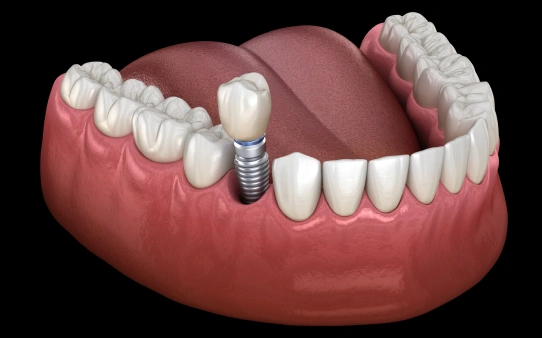
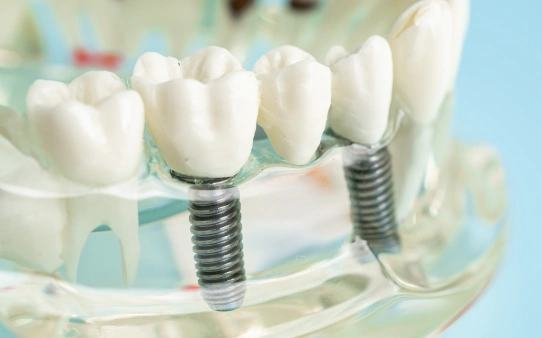
Tap to switch. A bridge is the better choice if both neighbors already have crowns.
The five that matter most:
If you wait
A gap is not a stable situation. Your mouth reacts to it, slowly, and the changes do not reverse on their own. Tap through five years.
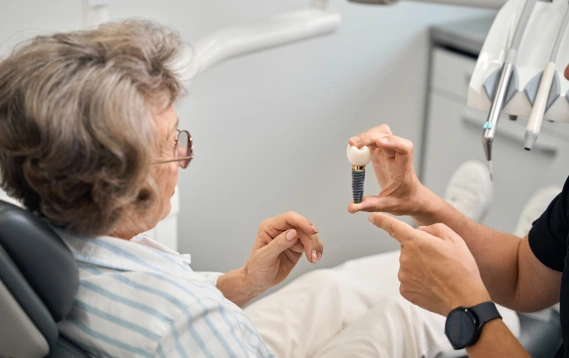
The five things that happen:
Front teeth also affect speech and how you look. Back teeth are quieter about it, which is why they get left longest and end up needing the most work.
Find out where you standPricing
The usual complaint about implant pricing is not that it is high. It is that the first number is not the final number.
Three items cause most of the surprises: the connector, the crown, and grafting. The first two are sometimes bundled with surgery and sometimes not. The third depends on your scan.
Tick the boxes and take the list to any consultation, including ours.
Many plans do not cover the implant itself but do pay toward removing the tooth, the graft, the connector or the crown, up to a yearly maximum. If that yearly cap is your limit, splitting treatment across two plan years can help. Financing through Proceed Finance is available, subject to approval.
Credentials
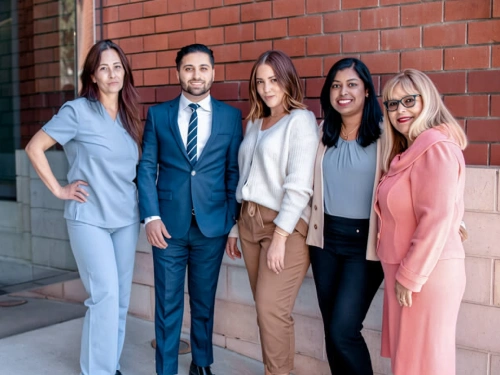
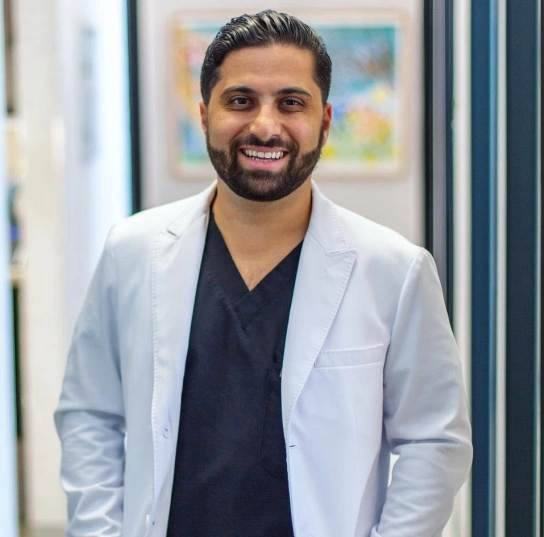
Oral and maxillofacial surgeon in Bakersfield. Implants, extractions and jaw surgery.
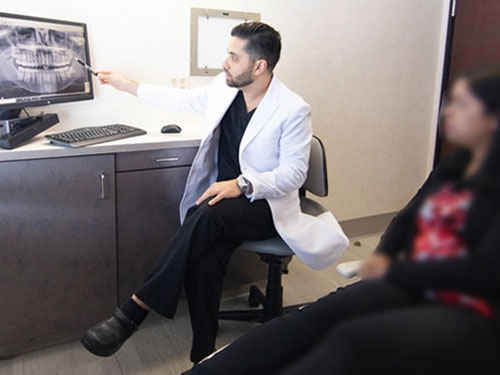
Exam, 3D scan, and a straight answer on whether you need a graft yet. You leave with a written itemized price. Holding a quote from another office? Bring it.
FAQ
Not during. You are numbed, sedated or fully asleep, whichever you pick.
Afterward, expect soreness and some swelling that peaks around day two or three, then settles. Most people manage with the medication they are given and go back to a desk job the next day.
Usually 3 to 6 months from placing the implant to fitting the crown, across four or five short visits.
Most of that time is just healing, with nothing for you to do. If the tooth still needs removing first, add 3 to 4 months.
For most single-tooth cases with healthy teeth either side, yes. A bridge works by shaving down both neighbors, so you end up treating three teeth to replace one.
A bridge is the better choice when both neighbors already have crowns or large fillings, when surgery is not advisable for you, or when it has to be finished in weeks.
It depends how long the tooth has been gone. Bone shrinks once nothing is pressing on it, fastest in the first year.
A recent gap often needs no graft. A gap left several years usually does. Your 3D scan answers it on the day.
That is the goal. Your site is scanned digitally and the crown is built to the color and shape of the teeth around it.
Front teeth take more care, because the gum around the crown matters as much as the crown. If your gum is thin, a zirconia implant avoids any gray showing at the gum line.
The implant itself is built to last decades with healthy gums and regular cleanings. The crown on top wears and may need replacing once or twice along the way.
What ends implants early is gum inflammation and bone loss around them. An implant has no nerve, so it will not ache to warn you. Keep your hygiene visits.
Your bone shrinks, the teeth either side tilt in, and the tooth above or below drops down. Your bite changes and your remaining teeth take more load.
Practically, waiting turns a simple implant into an implant plus a graft, and sometimes braces to reopen the space. Delay costs more than it saves.
Age on its own is not a barrier. Plenty of patients in their seventies and eighties have implants placed successfully.
What matters is your bone, your gum health and your general medical picture. Uncontrolled diabetes, smoking and some bone medications affect healing and are reviewed before surgery.
Yes, but the failure rate is higher, at every stage. Smoking reduces blood supply to healing bone and gum.
Stopping for the healing period makes a measurable difference. It is the single most useful thing you can control about the outcome.
Location
Serving: Bakersfield, Beverly Hills, Century City, Westwood, Brentwood, West Hollywood, Santa Monica, Bel Air, Sherman Oaks, Culver City and the greater West Los Angeles area.
Book a Consultation