Dental Implants Bakersfield/ Zirconia Dental Implants in Bakersfield, CA
Metal-free ceramicBest for thin gumBoth materials offeredSecond opinions welcome
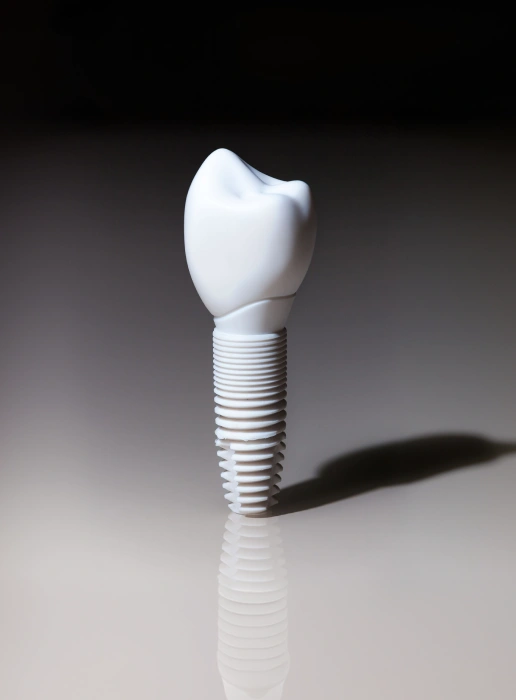
A white ceramic implant with no metal in it. The right choice for a front tooth where your gum is thin, and for anyone who would rather avoid metal altogether.

 ADA
American Dental Association
ADA
American Dental Association
 Calaoms
California Association Of Oral and Maxillofacial Surgeons
Calaoms
California Association Of Oral and Maxillofacial Surgeons
 ABOMS
American Board of Oral and Maxillofacial Surgery
ABOMS
American Board of Oral and Maxillofacial Surgery
 AAOMS
American Association of Oral and Maxillofacial Surgeons
AAOMS
American Association of Oral and Maxillofacial Surgeons
 Board-Certified ABOMS
Board-Certified Oral & Maxillofacial Surgeon
Board-Certified ABOMS
Board-Certified Oral & Maxillofacial Surgeon
Overview
A zirconia implant does the same job as a titanium one. It is placed in your jawbone, bone grows onto it, and a crown goes on top.
The difference is what it is made of. Zirconia is a white ceramic, so there is no metal anywhere in it.
That matters in two situations:
Outside those two situations, titanium is usually the better pick. This page says where each one wins.
Most implant crowns are already zirconia, sitting on a titanium implant. A zirconia implant means the part inside your bone is ceramic too. Different thing, worth checking which you are being quoted.
How it works
Placement is much the same as titanium. The design is where zirconia differs, and it affects your treatment in ways worth knowing.
| Most zirconia | Most titanium | |
|---|---|---|
| Built as | One solid piece | Two parts that join |
| Top sits | Above the gum from day one | Buried while it heals |
| Angle correction | Not possible after placing | Yes, at the connector stage |
| Crown attaches by | Cement | Screw, usually |
| Placement accuracy | Has to be exact first time | More room to adjust later |
| Narrow widths | Fewer options | Widely available |
Because a one-piece implant is also its own connector, where it points is decided the moment it goes in. There is no second chance to adjust the angle later.
What follows from that:
Two-piece zirconia implants do exist and remove some of these limits. Fewer systems offer them, and they have less history behind them again.
Yes. Modern zirconia surfaces are roughened so bone locks on much as it does to titanium. The published success rates are good. They just do not stretch back as many decades.
Timeline
Almost identical to a titanium single implant, with two differences.
What is the same:
What is different:
Drag the slider for each stage.
Something knocks the exposed top, your temporary starts to touch it, or pain increases after day three instead of easing.
Six stages from consultation to finished crown.
Benefits
Tap between the two materials. Both panels show the same front tooth site with thin gum, which is the case where the difference is visible.
Tap to switch. Neither is better everywhere. It depends on the site.
Choose zirconia when:
Titanium is the better choice when:
If you choose metal
This is the specific problem zirconia exists to prevent, and it only shows up years after the decision is made. Tap through a decade on a front tooth with thin gum.

Why it catches people out:
None of this applies to a back tooth, and it barely applies if your gum is thick. That is why this is a site-by-site decision rather than a rule.
Ask about your gum thicknessPricing
Zirconia implants cost more than titanium. The fixture itself is more expensive, and fewer manufacturers make them.
So the question worth asking is what the extra buys you in your case. On a front tooth with thin gum, it buys an outcome titanium cannot guarantee. On a back molar, it mostly buys the fact that it is not metal.
Ask for both quotes side by side. Any office that will only quote one material is not really giving you a choice.
Plans treat both materials the same way, so choosing ceramic does not change your coverage either way. Whatever a plan pays toward an implant, extraction or crown applies the same. Financing through Proceed Finance is available, subject to approval.
Credentials
Dr. Sam Harouni, DDS. Oral and maxillofacial surgeon in Bakersfield.
A one-piece implant has to be placed at exactly the right angle first time, because there is no adjusting it afterward. That is the main reason ceramic asks more of the surgeon than titanium does.

Exam, 3D scan and a measurement of your gum thickness, which is what actually decides this. You leave with quotes for both materials so you can compare them properly.
FAQ
It is harder, but more brittle. Titanium bends slightly under extreme force where ceramic is likelier to fracture.
For normal chewing at a front tooth this is not a practical concern. For a heavy bite on a back molar, or if you grind, titanium is generally the safer engineering choice.
Possibly, but confirm it first. True titanium allergy is genuinely rare, and titanium is used throughout medicine partly because the body tolerates it so well.
If you have reacted to jewelry or other implanted metal, testing is worth doing before deciding. If you simply prefer no metal, that is a fair reason on its own and does not need a test.
Because the top of it is not buried. It passes through the gum, and gum tissue is slightly translucent.
If your gum is thin, a gray implant can read through as a shadow at the margin, and more so if the gum recedes a little over the years. On a back tooth nobody sees it. On a front tooth it is the whole question.
Most zirconia implants are made as a single unit, so the part in your bone and the part the crown sits on are one piece of ceramic.
It means the angle is fixed at placement with no adjusting later, the top is exposed while it heals rather than buried, and the crown is cemented on rather than screwed. Precise planning matters more as a result.
Not every case. It comes in fewer widths, so a narrow gap may not have a ceramic option that fits.
It is also less commonly chosen for back teeth, where heavy chewing favors titanium and nobody can see the implant anyway. Front teeth are where it earns its place.
Yes. The fixture itself costs more and fewer manufacturers make them.
What matters is what the difference buys you. At a front tooth with thin gum it prevents an outcome titanium cannot rule out. At a back molar it mainly buys the absence of metal. Ask for both quotes side by side.
Modern ceramic implants have been in clinical use for roughly two decades, and published success rates over that period are good.
Titanium goes back much further, with research spanning far longer. If having the longest possible track record is your priority, that is a fair reason to choose titanium.
Yes, and that is what most implant crowns already are. A white zirconia crown on a titanium fixture is the standard combination.
It is worth being clear which you are being quoted. A zirconia crown does not make the implant metal-free, and it does not prevent a gray shadow, because the metal is still the part passing through your gum.
Often slightly better, yes. Gum tissue tends to sit closely against zirconia, and ceramic attracts a little less plaque than metal does.
The bigger factor is simply that there is nothing dark underneath. Even if the gum recedes a millimeter over the years, what shows is white rather than gray.
Location
Serving: Bakersfield, Beverly Hills, Century City, Westwood, Brentwood, West Hollywood, Santa Monica, Bel Air, Sherman Oaks, Culver City and the greater West Los Angeles area.
Book a Consultation