Dental Implants Bakersfield/ Zygomatic Implants in Bakersfield, CA
For severe bone lossOne surgery, not a yearGeneral anesthesia hereSecond opinions welcome
Implants anchored in your cheekbone instead of your upper jaw. The option for people told they have too little bone, or whose bone graft failed.

 ADA
American Dental Association
ADA
American Dental Association
 Calaoms
California Association Of Oral and Maxillofacial Surgeons
Calaoms
California Association Of Oral and Maxillofacial Surgeons
 ABOMS
American Board of Oral and Maxillofacial Surgery
ABOMS
American Board of Oral and Maxillofacial Surgery
 AAOMS
American Association of Oral and Maxillofacial Surgeons
AAOMS
American Association of Oral and Maxillofacial Surgeons
 Board-Certified ABOMS
Board-Certified Oral & Maxillofacial Surgeon
Board-Certified ABOMS
Board-Certified Oral & Maxillofacial Surgeon
Overview
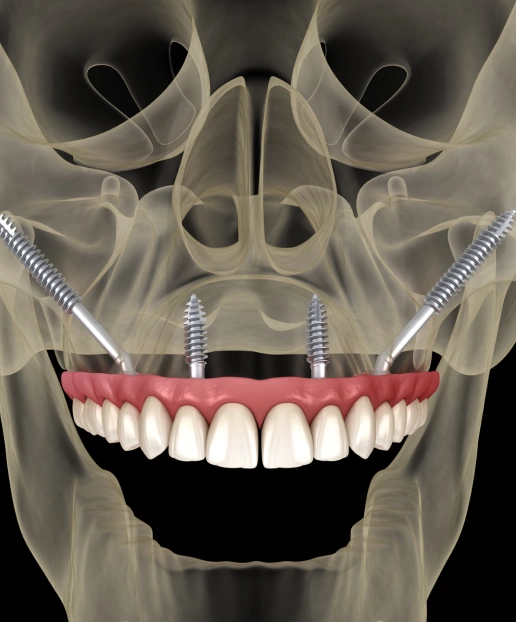
A zygomatic implant is a long implant that anchors into your cheekbone instead of your upper jaw.
It exists for one reason. When the upper jaw has thinned to the point where a normal implant has nothing to hold onto, your cheekbone is still solid, and it stays solid because it never held teeth in the first place.
This is the treatment for people who have been told:
That last one is worth pushing back on. It usually means the office you asked does not perform this surgery, which is a different statement.
This is the largest operation on this website. It is done under general anesthesia, takes several hours, and needs a surgeon trained in operating around the sinus and the eye socket. The page below is honest about what that involves.
How it works
Tap through five stages. The idea is simple even though the surgery is not: stop trying to build bone where it has gone, and anchor somewhere it never left.

A standard implant is about 8 to 13 millimeters long. A zygomatic implant can be three or four times that, because it has to travel from your gum line up into the cheekbone.
Why the cheekbone works:
How many: usually two, one on each side. Some cases use four, two per side, when there is nothing usable at the front either. Often two zygomatic implants are combined with two standard implants at the front.
Grip in solid cheekbone is usually strong enough to carry a bridge immediately. That is why this operation, despite being the biggest, often gets you fixed teeth faster than grafting would.
Timeline
Everything else on this site is minor surgery by comparison. Being straight about this one matters more than making it sound easy.
What it involves:
The risks worth knowing:
Published survival rates for zygomatic implants placed by experienced surgeons are high, comparable to conventional implants. The variable that matters most is who is doing it.
Drag the slider for each stage of recovery.
Six stages from consultation to the final bridge.
Benefits
The real comparison is not against doing nothing. It is against the grafting route, which is the other way to get implants into a jaw that has lost its bone. Tap between them.
Tap to switch. Both are legitimate. The trade is one big surgery against many months.
What the zygomatic route gives you:
Where grafting wins: it uses standard implants with the longest track record of anything in dentistry, and each individual surgery is smaller. If you have the time and the bone to graft onto, it is a perfectly sound route.
If you accept no
The upper jaw has a problem the lower jaw does not. As the ridge is lost, the sinus above expands down into the space, so you lose bone from both directions. Tap through a decade.

Why waiting costs more here than anywhere else:
A scan and a conversation cost you an appointment. Being told no once is not a reason never to ask again.
Get a second opinionPricing
This is the most expensive treatment on the site, and the comparison people usually get wrong is against the alternative rather than against a standard implant.
Grafting your way to the same result means several surgeries, several healing periods, and a year or more of your life. Add those up and the gap narrows considerably.
The two biggest items are the general anesthesia and the number of zygomatic implants. Ask for both as named lines.
Worth exploring more than usual here. Because this is significant surgery under general anesthesia, medical plans sometimes engage where dental plans will not. We will file a pre-estimate with both. Financing through Proceed Finance is available, subject to approval.
Credentials
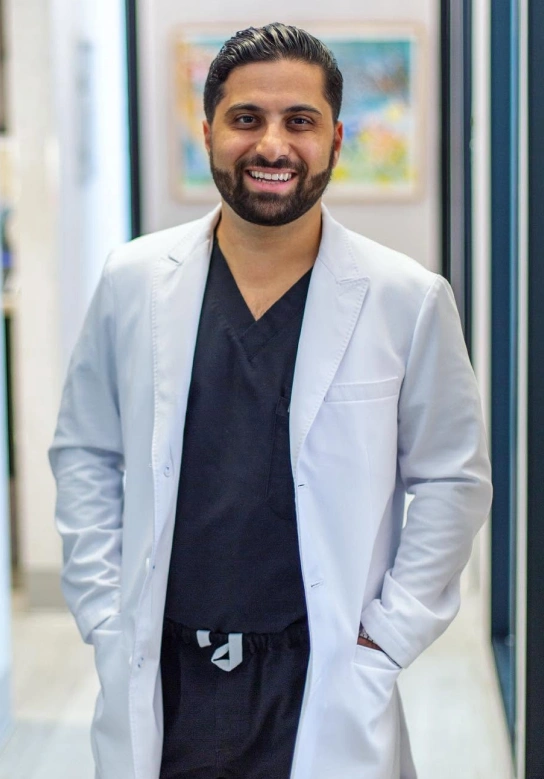
Dr. Sam Harouni, DDS. Oral and maxillofacial surgeon in Bakersfield.
Most dentists who place implants do not perform this operation, and that is reasonable. The path runs near the sinus and the eye socket, it needs general anesthesia, and the training for it comes from hospital-based surgical residency rather than an implant course.
That is the single most important variable in the outcome, so it is worth asking any surgeon directly how many they have done.
Exam, 3D scan of your cheekbones and sinuses, and a straight answer on whether this is possible for you. If you have a refusal or a scan from another office, bring both.
FAQ
Often it means the office you asked does not perform this operation, which is a different thing from it being impossible.
Zygomatic implants do not rely on your upper jaw at all, so the amount of ridge you have left is not the deciding factor. What matters is your cheekbone, which is almost always intact. A scan settles it.
In experienced hands, published survival rates are high and comparable to conventional implants. It is still a bigger operation than anything else on this site.
The most commonly reported complication is sinus inflammation, since the implant passes close to or through the sinus. It is usually treatable and occasionally needs an ENT specialist. Temporary numbness of the cheek or lip can occur. The path also runs near the eye socket, which is why 3D planning and the surgeon's training matter more here than anywhere else.
Usually yes. Because the cheekbone is dense, the implants normally grip firmly enough to carry a fixed bridge immediately.
That is one of the strongest arguments for this route. The grafting alternative typically means a year or more in a denture before you get fixed teeth.
Yes. This is done under general anesthesia rather than sedation, and it is given in this office rather than referred out to a hospital.
Surgery takes three to five hours. You go home the same day, and you will need someone to drive you and ideally stay with you that evening.
Considerably more swelling and bruising, including under the eyes and across the cheeks, peaking around day three. It looks worse than it feels.
Plan a week away from anything public and about two weeks before you feel like yourself. You will also be asked not to blow your nose for a period, because of the sinus. Soft food runs about three months, the same as any immediately loaded full arch.
Not necessarily. General anesthesia is administered in this office, which is possible because oral and maxillofacial surgery training includes anesthesia.
Some patients or medical histories are better suited to a hospital setting, and that is assessed before surgery rather than assumed either way.
Usually two, one on each side. Four are used when there is nothing usable at the front of the jaw either, two per side.
A common arrangement is two zygomatic implants at the back combined with two standard implants at the front, where a little bone often remains.
No, and it is one of the most common reasons patients end up here. A failed graft does not affect your cheekbone.
Any remaining graft material sometimes needs removing first, which is done in the same operation. Bring the records from the previous attempt if you have them.
They are designed as a long-term solution and reported survival at ten years is comparable to conventional implants placed in good bone.
The bridge on top is the wearing part and may need replacing across that time. Maintenance matters: cleaning underneath daily, checkups twice a year, and having the sinuses reviewed as part of those visits.
Location
Serving: Bakersfield, Beverly Hills, Century City, Westwood, Brentwood, West Hollywood, Santa Monica, Bel Air, Sherman Oaks, Culver City and the greater West Los Angeles area.
Book a Consultation